Showing posts with label dictatorship. Show all posts

Wednesday, 19 March 2014

Update on Lockerbie.


In the latest Al-Jazeera documentary on the Lockerbie bombing a former Iranian intelligence officer was interviewed. Abolghassem Mesbahi claims that Tehran decided to retaliate against the US after the USS Vincennes shot down Iran Air Flight 655 in July 1988.  As an intelligence officer Mesbahi answered to President Rafsanjani and claimed Ayatollah Khomeini backed the plan to avenge Flight 655. The civilian airliner was mistaken for an F14 Tomcat about to attack and shot down over the Persian Gulf and 290 people died. Alexander Cockburn and Ken Silverstein reported back in 1988: "A pair of binoculars could have told the officers of the Vincennes what was flying overhead. But binoculars don’t cost half a billion dollars. The more complex the weaponry, the deeper the pork barrel and the more swollen the bottom line." It was in December 1988 that Pan Am Flight 103 exploded over Lockerbie, Scotland, killing 270 people.

It seems plausible. In 1996 the Clinton administration cut a deal with President Rafsanjani to compensate the families of the victims with payments of over $200,000 per passenger amounting to more than $60 million. A part of the deal was that the US government did not apologise nor admit any responsibility for what it maintains was a 'mistake'. The Iranian government has consistently disputed this claim. Al-Jazeera interviewed Robert Baer, a former CIA agent, who claims that the Iranians turned to a free-lance Palestinian group to take down five planes. The group in question has been named by various sources as the Popular Front for the Liberation of Palestine - General Command (PFLP-GC for short). The main problem is that we may never know the full truth as the trial of al-Megrahi was clearly so flawed. It's doubtful that there will be any retrospective investigation.

Al-Jazeera has covered this subject before. In 2011 the channel gave a platform to Scottish defence investigator George Thomson, who claims that the forensic evidence against al-Megrahi was "inaccurate" and may have been contaminated. In 2012 Al-Jazeera interviewed al-Megrahi on his deathbed and revealed that the Scottish Criminal Case Review Commission had re-examined the case and had recommended it be referred back to the courts. I've covered this story myself on and off since 2009 when al-Megrahi was released on compassionate grounds to the outrage of the US hawks and their British sycophants. I first came across the claims in an article by John Pilger, which I drew heavily on in my early writing on this subject. Since then a lot has transpired in Libya, the Gaddafi regime disintegrated before a NATO onslaught and the country now seems to be rapidly descending into anarchy.

After Al-Jazeera released its documentary the BBC, the Independent, the Daily Mail, and the Telegraph, have given the claims coverage. With both Gaddafi and al-Megrahi in the ground it may be time for a serious reflection on what went on in 1988 and how the Lockerbie case was handled in the British legal system. It certainly seems that the UK media has opened itself to the possibility that Iran retaliated and that in turn opens up all kinds of troubling questions.

Wednesday, 5 September 2012

Weakspots of Despotism.


The theorist of non-violent resistance Gene Sharp has been credited as the major intellectual influence on the Arab Spring. It was seminal book From Dictatorship to Democracy that has been cited as the principle inspiration for the grass-roots uprisings all over the Middle East and democratic movements elsewhere. Let's be careful not attribute too much to Sharp, the revolutionary explosion came out of certain socio-economic conditions in the region. We shouldn't exaggerate the role of external sparks, the democratic movements of the Middle East were endogenous. To suggest otherwise risks the reinforcement of Orientalist illusions of a primitive Arab rabble, 'It had to be our revolution really, they couldn't have done it on their own!' But it was interesting to flick through Sharp's book and I recommend it. In regard to political power it cites the following sources:

1. Authority, the belief among the people that the regime is legitimate, and that they have a moral duty to obey it;
2. Human resources, the number and the importance of the persons and groups which are obeying, cooperating, or providing assistance to the rulers;
3. Stills and knowledge, needed by the regime to perform specific actions and supplied by the cooperating persons and groups;
4. Intangible factors, psychological and ideological factors that may induce people to obey and assist the rulers;
5. Material resources, the degree to which the rulers control or have access to property, natural resources, financial resources, the economic system, and means of communication and transportation; and
6. Sanctions, punishments, threatened or applied, against the disobedient and non-cooperative to ensure the submission and cooperation that are needed for the regime to exist and carry out its policies.

Sharp notes that each of these sources in turn presupposes a degree of acceptance of the regime, whether it just be submission or complicity, which is not guaranteed. This is very interesting with regard to the section on the weaknesses of dictatorships, which lists the following weaknesses:

1. The cooperation of a multitude of people, groups, and institutions needed to operate the system may be restricted or withdrawn.
2. The requirements and effects of the regime's past policies will somewhat limit its present ability to adopt and implement conflicting policies.
3. The system may become routine in its operation, less able to adjust quickly to new situations.
4. Personnel and resources already allocated for existing tasks will not be easily available for new needs.
5. Subordinates fearful of displeasing their superiors may not report  accurate or complete information needed by the dictators to make decisions.
6. The ideology may erode, and myths and symbols of the system may become unstable.
7. If a strong ideology is present that influences one's view of reality, firm adherence to it may cause inattention to actual conditions and needs.
8. Deteriorating efficiency and competency of the bureaucracy, or excessive controls and regulations, may make the system's policies and operation ineffective.
9. Internal institutional conflicts and personal rivalries and hostilities may harm, and even disrupt, the operation of the dictatorship.
10. Intellectuals and students may become restless in response to conditions, restrictions, doctrinalism, and repression.
11. The general public may over time become apathetic, skeptical, and even hostile to the regime.
12. Regional, class, cultural, or national differences may become acute.
13. The power hierarchy of the dictatorship is always unstable to some degree, and at times extremely so Individuals do not only remain in the same position in the ranking, but may rise or fall to other ranks or be removed entirely and replaced by new persons.
14. Sections of the police or military forces may act to achieve their own objectives, even against the will of established dictators, including by coup d'etat.
15. If the dictatorship is new, time is required for it to become well established.
16. With so many decisions made by so few peole in the dictatorship, mistakes of judgment, policy, and action are likely to occur.
17. If the regime seeks to avoid these dangers and decentralizes controls and decision making, its control over the central levers of power may be further eroded.

Sunday, 29 April 2012

Bastards in Bahrain.


Well the Grand Prix maintained its record of holding races in horrible regimes. The little island of Bahrain is just the most recent example, but there were the races in Apartheid South Africa and Fascist Spain of yesteryear. It was good to find updates in the mainstream, just a glimpse at the courageous pro-democracy movement: particularly the ongoing hunger strike by Abdulhadi al-Khawaja. The most recent protests and deaths at the hands of the police forces have received much more attention than they would have otherwise. The repression in Bahrain now has John Yates, once a candidate for the top job in the Met, to defend the House of Khalifa. Well, you've got to pay the mortgage somehow! On top of this, King Hamad has been invited to dine at the celebrations of the Queen's Jubilee. All of this comes over a year since the Saudi intervention in Bahrain was waged. The intervention embodied the West's anxiety at the prospect of democracy in the Middle East.

First it was Bahrain, then it was Libya. By then, Ben Ali and Mubarak had been swept away by the revolutionary contagion spreading rapidly from country to country. You can say it was oil in Libya, but you can't simply say that about Bahrain. The island isn't simply a major oil-producer unlike it's neighbours. There is a reason that the US Fifth Fleet is stationed in Bahrain, it is well situated to defend the status quo. In the West the fear was that the uprising would establish a Shi'ite dominated state in the Gulf. This would go far to undermine the Arab facade of US client-states which keep a friendly hand on the oil spigot. It could mean a new ally for Iran, not to mention give ideas to the Shi'ite dominated eastern province of Saudi Arabia. This is at a time when the Iraqi government is looking to avoid another war with Iran and instead wants stable relations. Meanwhile a civil war rages in Syria with the Ba'ath Party just about clinging to power, its talons bloody as ever.

As with the violent repressions in Syria and Libya, the reason given in Bahrain was to defend the nation from 'foreign interference'. Similarly, in Egypt, Mubarak had anti-Semitic propaganda distributed as he called on Bibi Netanyahu to send the IDF into Tahrir Square. By then it was too late to save the tyrant, the military shunted Mubarak out of office hoping to buy-off the opposition. Meanwhile the Israeli political class watched with great unease as the US gave up on blocking elections in Egypt after it became impossible to save the dictator. And for good reason, Egypt has been a vital US proxy since Sadat dragged the country into a tacit alliance with Israel in the 1970s. By then Sadat had already imposed market reforms which destroyed the country's middle-class and opened the door to corruption. After the rebellions of 2011 suppressed, the serious question for the House of Khalifa is how to reformulate the old order.

Ironically, it was in eastern Arabia that a esoteric Ismaili sect set out to build a society based on reason and equality. By 899 the Qarmatians had established a utopian republic in what is now Bahrain. Its system of governance consisted of a council of six with a chief who was the first among equals. Out of a millenarian fervour the Qarmatians sacked Mecca in 930, stealing the Black Stone and dumping dead pilgrims in the Well of Zamzam. The Qarmatians may have first attempted to redirect the pilgrimage away from Mecca before holding it for ransom. Whatever the case, over 20 years later, the Black Stone was left shattered in the Great Mosque of Kufa in Iraq. The opportunity to seize control had come for the Qarmatians from the aftermath of the slave rebellion in Basra, which raged from 869 to 883 and had left Baghdad diminished in power. Hundreds of thousands of slaves participated as the rebels held that the most qualified man should reign - even if he is a black slave.

Even in recent history, Bahrain has seen uprisings and significant protest over the last 20 years for democracy with the state managing to fend-off each successive wave of opposition. Given that Bahrain is an important artery to the heart of capitalism in the Middle East, it may mean that the GCC itself has to been shaken up sufficiently to bring about democratic change. This would mean serious change in Saudi Arabia, Qatar, Oman, Kuwait and the UAE.  Notice there has been no regime change and no reform in any of these states. The repression was swift to prevent any serious opposition from even appearing on the streets. This is where most of the power in the region is concentrated, the epicentre of capital accumulation from an unsustainable energy trade. The Arab Spring has shaken a rotten status quo in the region to its core, but has yet to fundamentally change the Middle East. This isn't to say that it has been a failure, far from it, it means that it has to go further.

Saturday, 3 September 2011

Gaddafi's Greatest Hits?


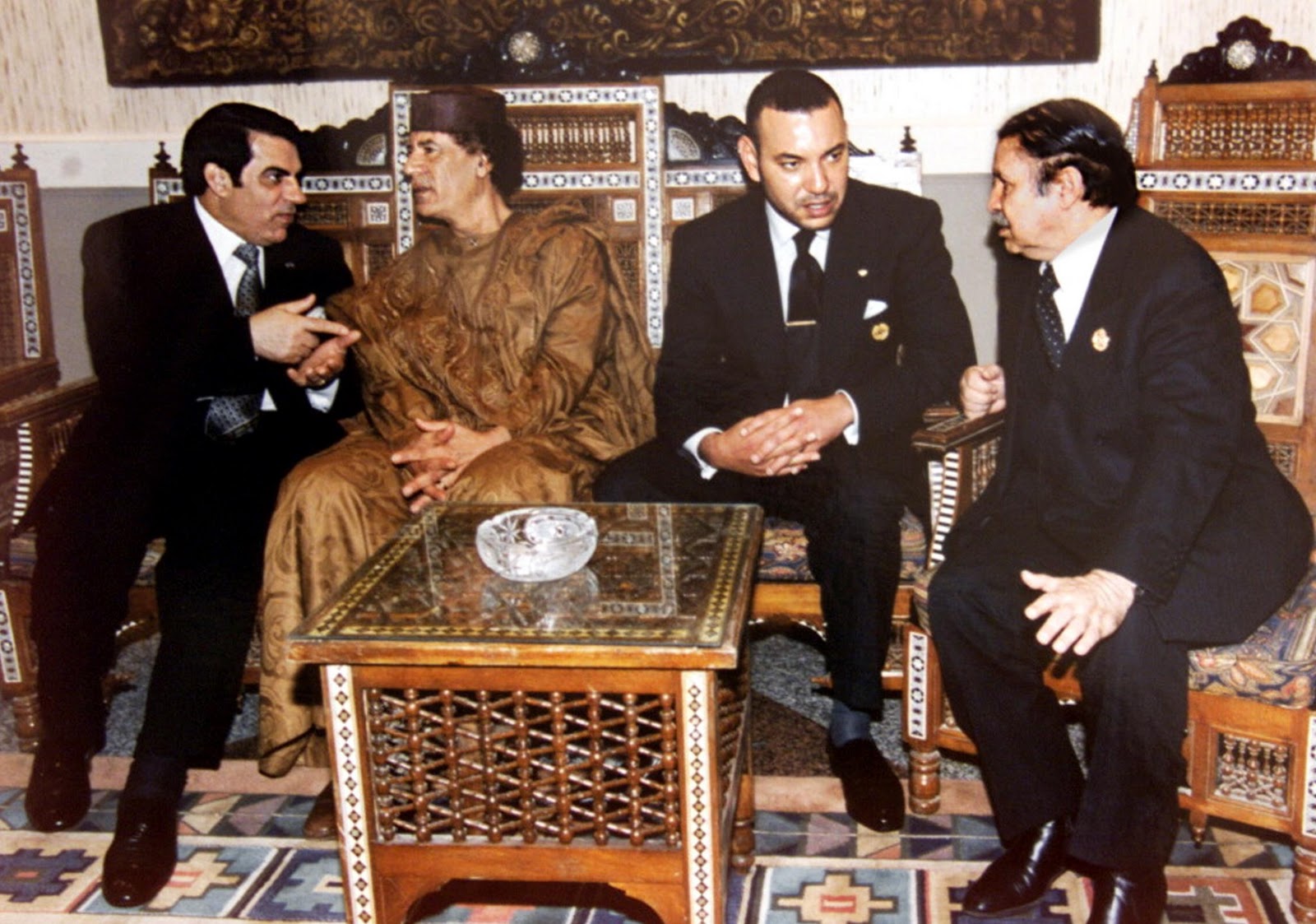
After Gaddafi reaffirmed his position in the mid 1970s the Libyan government continued to embark upon an interventionist path abroad. In the 70s the regime stood shoulder-to-shoulder with Idi Amin in Uganda as it propped up the ANC in South Africa. Repeatedly Gaddafi interfered in the politics of other Arab states, holding that the Arab people are for unity and the rulers stand in the way. A series of plots against leaders in other countries were uncovered, including in Egypt and Tunisia. Gaddafi played the part of a revolutionary looking to liberate the masses of the Arab world and to unite the Arab states carved out in colonial times. The Colonel argued that it is a moral duty to support every movement that stands for the liberation of the exploited and oppressed. This is where Gaddafi comes across as a strange parallel of a liberal interventionist, perhaps one of those self-proclaimed "democratic revolutionaries" who fought to bring American pornography to Russia. Gaddafi has also acted to mediate disputes in African countries such as Mali, specifically between the government and rebels. He has even sent peace keeping missions to countries.


By 1980 it was clear that there was dissent within Libya which the Colonel acted to suppress. There was a mutiny in the Libyan army at Tobruk which Gaddafi crushed. There were numerous assassination attempts over the years and the self-proclaimed "Brother Leader of the Revolution" had survived a coup attempt thanks to the CIA. Rocky times lay ahead as Libya went to war with Chad, with the US, Saudi Arabia, Egypt and Israel supporting Chad. Around the same time the Libyan government was looking to align itself with the Soviet Union as it saw the writing on the wall from the US. Even though just the year before Billy Carter attended the 10th anniversary celebrations of the Gaddafi's ascent to power. By which point the CIA had definitely abandoned its' pragmatic position on the Libyan government. There was soon little tolerance for Gaddafi as he lent support to the Sandinista movement that had deposed the vile Somoza in Nicaragua. The Americans were looking to keep their "backyard" in order.

In 1981 the Reagan administration declared the "War on Terrorism" and shot down two Libyan fighter jets in disputed waters before Reagan ordered US citizens to leave Libya and then refused US passport holders to travel there. Before the year was out the Reaganites were claiming that the Colonel had sent hit-men to assassinate the President and would target senior officials if Reagan couldn't be got. The line was played to deliberately invoke the assassination attempt that Reagan survived. It was a well crafted campaign of fear on the part of the American government and actually originates as a piece of Israeli secret service disinformation. Similarly in Britain The News of the World ran a story that the Libyan government was "masterminding a secret plot to arm black revolutionary murder squads" in the country. The British press has been jingoistically faithful to the cause of bombing Libya for quite some time. The source turned out to be a notorious con artist, who had squeezed £3,000 out of the paper for the story. Around the time that there were meant to be Libyan hit-men hiding under the President's bed a CIA plot to overthrow Gaddafi was leaked to the press.


In 1982 the CIA installed Hissène Habré in Chad as the war still raged with Libya. The aims of this were clear as Alexander Haig wanted to "bloody" Gaddafi's nose and it was the first operation carried out by new CIA chief William Casey. The National Front for the Salvation of Libya received $7 million from the Saudi Royals, as well as support from the CIA and the French. A plan to assassinate Gaddafi and overthrow the government was crushed in May of 1984. For the British the death of police officer Yvonne Fletcher in April of 1984, at the hands of a gunman inside the Libyan embassy, was enough to pin Colonel Gaddafi as the "Mad Dog" leader of a rogue state. There wasn't such fuss over the fate of Musa Sadr, who disappeared mysteriously on a trip to Libya in 1978. The Lebanese Imam had a significant following amongst Shi'ite Muslims, but had a reputation as politically unreliable though it remains a mystery precisely why Gaddafi would have killed him. Then in 1985 came the plan for an Egyptian invasion of Libya aimed at the removal of Gaddafi from power. Mubarak refused to carry out the invasion for Washington.

Finally in 1986 the US bombed Libya on the grounds that the Gaddafi regime was supporting international terrorism. It was the first military assault on a country that was staged for prime time television. No European country, except for Britain, would allow the US to launch the attack from its military bases. Thatcher was looking for a boost in the polls and hoped that the attack on Libya might propel her to victory in '87 as the Falklands war had in '83. The airstrikes failed to hit some major targets, the Colonel survived the attack, even cabinet ministers questioned the bombing and the British public were not impressed. Out of the 18 jets sent to bomb Libya 9 had been given the order to takeout the "Mad Dog". The attack on the compound was a military failure, Gaddafi was in a bunker at the time and only the windows on the administration building where he lived were blown out by the bombs. Though the tennis courts sustained two bombs and it only took one blast on the building where Gaddafi's family lives to injure two of his sons and kill his adopted daughter. Can you imagine the outrage of the commentariat had Reagan's daughter been killed in a Libyan air-raid on the US?


One of the specific charges against the Colonel was that he had sent advisers and arms to the Sandinistas in Nicaragua. Interestingly it would not be acceptable for Libya to bomb the US for the weapons and funds it gave to the Contras to bring down the Sandinista government by any means necessary. This is where Gaddafi acted as a mirror-image of an American neoconservative. He saw the same moral obligation to intervene where necessary on the side of the victim, preferably a victim valuable in some geopolitical sense. So Gaddafi supported the Sandinistas against the US, the Palestinians against the Israelis and the Irish against the British. This is the same reason Gaddafi would use to defend sending Libyan agents to subvert the Sadat government in Egypt. Then came the charges of terrorism, there was the Berlin Disco Bombing in 1986 which was immediately linked to the Libyan regime. The American neoconservatives jumped at the opportunity to "liberate" the Libyan people from the police state Gaddafi had built. Even though there was no evidence, at the time, that the bombing had anything to do with Gaddafi. It had been suggested that the attack might have been orchestrated by Iran or Syria.

After the airstrikes the CIA went on to launch an extensive effort to launch a coup in Libya, a secret army was put together from the Libyans captured in border battles with Chad. Then came the Lockerbie Bombing in December of 1988 which sent Pan Am Flight 103 down in flames, leaving 270 people dead. In August of the same year the USS Vincennes shot down an Iran Air Flight 665 over the Persian Gulf and 290 people were killed. It was written off as an "accident" in the US, though that is disputed by Tehran. It seems plausible that the bombing was orchestrated by a Palestinian group hired by the Iranian regime to take revenge against the US. But this is just a theory which has yet to be proven because of the absence of a serious investigation into the shooting down of Pan Am Flight 103 and Iran Air Flight 665. The indictments for Abdelbaset al-Megrahi and Khalifa Fahimah were handed down after Libya opposed the Gulf War. Fahimah was acquitted but al-Megrahi was convicted on the testimony of two witnesses, who received around $7 million from the Rewards for Justice programme at the Justice Department. One witness testified that he sold clothes to al-Megrahi, which were later recovered from the wreckage, the other (a CIA informant) claimed he saw Fahimah carrying the bomb onto the plane.


By this point sanctions had been deployed against Libya for a number of years. Britain had resorted to funding various opposition groups in Libya. Then MI6 put together a plan to kill Gaddafi in 1996 and saw to it that his motorcade was attacked by Islamists (who had been paid £100,000 to kill the Libyan leader). Gaddafi got away with his life but six bystanders were left dead. No surprise given that the weapons used included Kalashnikovs and rocket-propelled grenades. This was the same year that the Colonel connived to slaughter around 1,200 political prisoners at Abu Salim Prison. The majority of which were Islamist and stood in opposition to the secular model Gaddafi favoured even as he introduced 'purification laws' that were based on Islamic scripture. The relatives of the prisoners were the backbone to the demonstrations held in Benghazi earlier this year. Gaddafi moved to crush the demonstrations and the rebellion was sparked. In the end it was the brutal nature of the regime that led to the uprising and not the decisions made in Washington. Now there are even rumours that the rebels have seized the prison and began releasing prisoners.

Colonel Gaddafi was aligned with Charles Taylor in the late 90s, just as he had backed monsters like Slobodan MiloÅ¡ević. This is the same man who had supported the ANC at a time when the British and the Americans attacked Nelson Mandela as a "terrorist". Gaddafi sought to invest millions in Liberia in order to maintain the stability of the Taylor government that was established through terror. As Liberia became embroiled in the bloodbath in Sierra Leone so did Libya to the extent that there was an attempt to indict Colonel Gaddafi as well as Charles Taylor. The charges amounted to the role Gaddafi had played in the mutilation, maiming and murder of 1.2 million people. The attempt to extend the trial to Gaddafi was blocked by the US and Britain in March of 2011. When asked "Why?" the chief prosecutor David Crane simply said "Welcome to the World of Oil." The support that the British and the Americans lent to Libya was extreme and embarrassing. Even the economic sanctions imposed against Libya specified a convenient exemption for Libyan banks. The aim being to reconstitute the regime along new lines which fit into Western interests in controlling the oil spicket of the region.


Once the Soviet Union had collapsed it was inevitable that the Gaddafi regime would open up to Britain and the US. The terrorist attacks on September 11th 2001 provided an opening for such negotiations with Blair. In the 1980s the economy had began to be deteriorate, as had the welfare state, which the sanctions imposed on the country only exacerbated further in the 1990s. So the Colonel looked for a normal relationship with the West and the regime began to slowly initiate neoliberal reforms. The welfare state and social services began to crumble as a result. At the same time corruption and unemployment spun out of control. Many of the reformists in the Libyan government, including those who have been linked to embezzling and corruption in the past, have since defected to the rebels. Perhaps then we know where the 200 million Libyan Dinars flown in from London will end up. In the meantime the Gaddafis will join the growing list of scum deposed this year and the corporate vultures will finally land to pick the bones clean. The reformists were behind agreements with the West over neoliberal reforms and no doubt we'll see plenty of that in days to come.

Friday, 2 September 2011

We are the People!


Freedom, Unity and Socialism.

The bloodless coup of 1969 followed a similar pattern as the Egyptian Revolution in 1952, when the last remnants of British power were overhauled by the Free Officers, Muammar al-Gaddafi was one of a coterie of military officials. In power the Colonel sought to model the regime on the pan-Arab and secular nationalist set up in Egypt, Gaddafi railed against the European colonial powers, America and Israel. Before his death in 1970 General Nasser said "I rather like Gaddafi. He reminds me of myself when I was that age." The Gaddafi regime forced out the British and American military bases and quickly moved to expel Westerners. At the same time the regime sought to craft a welfare system to provide universal health-care, education and affordable housing which fed into an anti-imperialist platform. The regime began to fund groups like the PLO, the ANC and the IRA. Gaddafi later described the system he was building as Islamic socialism, it might be more accurately described as Islamic Maoism. The country began to resemble an African Cuba.

The exact nature of links between the regime with the US and Britain were ambiguous in the early days, though a young Muammar al-Gaddafi had been on a military training course in Britain in 1966. With one British official stating "We thought he was a bit left-wing, but not too bad, and that we could deal with him." There have even been suggestions that the US backed the coup. The former Libyan Prime Minister Abdul Hamid Bakoush claimed "The Americans had contacts with Gaddafi through the embassy in Tripoli. They encouraged him to take over. There were dozens of CIA operatives in Libya at that time and they knew what was going on. The Americans were frightened of the senior officers and the intelligentsia in Libya because they thought that these people were independent and could not be run as puppets." We should keep in mind that Bakoush refused to give any names that might corroborate this theory. The rise of a new regime in Libya might have been interpreted as a chance to avoid a violent insurrection which might lead the country into the tentacles of the Soviet Union.

It is certain that there was serious concern about the reforms initiated under Gaddafi and the threat Libya would pose as a model for independence. The end of the monarchy and the construction of a welfare state might have "bought off" socialism for the time being, but what happens when other countries look to Libya as an example. This was the threat posed by the rise of General Nasser in Egypt and the desperation of the British to crush Arab nationalism. So in 1971 the CIA and MI6 put together a plot to bring down Gaddafi as part of an all-out-invasion of Libya, which would culminate in the release of political prisoners and the restoration of the monarchy. Ultimately, the plot fell apart because the CIA decided that the Gaddafi regime posed a sufficient bulwark to Communism in North Africa. Although the Gaddafi regime was opposed to the state of Israel and what it deemed Western imperialism, the  same regime stood in opposition to Soviet influence in the region. This was enough for the Americans, the British just had to shut up and grit their teeth.

Cracks began to emerge in the regime as a schism opened up between a serious commitment to socio-economic development and the interventionist foreign policy. In 1975 came an attempt to overthrow Gaddafi, which was crushed when the CIA notified him of the plot and the opposition were either exiled or imprisoned. After this Gaddafi began to undermine all aspects of Libyan society which might pose a threat to him in the long-term future, e.g. the military and the trade unions. The security apparatus became much more powerful. The sanctions later imposed by the UN and the US only furthered this process to the extent that corruption became endemic within Libya. By 2010 Gaddafi had seen to it that only 1.2% of GDP was spent on the Libyan military. The weapons and military equipment were either old models from the Soviet Union or had been recently imported from Britain and the US. The regime experienced a degree of immunity because of the government's reliance on oil revenue, as well as on the Soviet Union for political support in the world as relations with the US "waned" after the first 10 years in power.

As a result of the power struggle the country underwent a series of significant changes as the regime became increasingly centred around Colonel Gaddafi. The old Arab nationalist flag was tossed aside along with the title of Libyan Arab Republic as Gaddafi brought out his Green Book. Gaddafi called it a "cultural revolution", though he might have pursued such changes as relations with Egypt soured in a bid to distinguish his regime from that of Sadat. Officially Libya became the most democratic country on earth, a direct democracy maintained through a string of committees - a "practical form" as Gaddafi put it - where the authority of the people comes first and foremost. In reality the Libyan state was comprised of committees which took orders from Gaddafi who fell back on an astonishing security apparatus to police society. A network of informants and spies was established throughout Libyan society. It was a system of bureaucracy he built to insulate and maintain his own power. When asked where the people fit into this system the Colonel gave the perfect Stalinist reply "We are the people. The Free Officers are the sons of poor families, they are the embodiment of the people."

This is the similar method of rule practiced in Cambodia by the Khmer Rouge, though Gaddafi was far less brutal than Pol Pot it remains an adequate comparison. The Khmer Rouge took the negation of the past to the furthest limit, but failed to create a new collectivity. The old order was just replaced with a primitive regime of egalitarian control and ruthless exploitation. The Free Officers broke apart the old remnants of colonialism and the monarchy only to fail at the construction of an egalitarian society. Instead the regime provided a vent to the rage of the victims of colonialism as it built an apparatus of repression, rather than build on the accomplishments made early on and eliminate poverty totally. Similarly, Gaddafi reigned in distance from power as the Libyan state was officially a form of direct democracy just as the Khmer Rouge refused to admit it was in power for a few years after it had seized the country. To inquire into the structure of state-power was considered a crime and the leaders were simply referred to as "Brother No.1", "Brother No.2" etc. while the ruling party was simply known as "Angka", which means "organisation". In the same way Gaddafi represented an authoritarian distance from power.

The Autumn of the Colonel.

Escape to Hell.

There is no sign of the Colonel, with his family safely in Algeria, after Tripoli was seized by Berber rebels from the West and not from the East which has since led to the National Transitional Council taking seat in Tripoli. The Berbers had been suppressed under Gaddafi and in the end the Berbers sought revenge against the regime. The disparate militias which comprise the rebels will no doubt hold onto territory and barter for political power. The rumours of his whereabouts continue, some say the Colonel is hauled up in a flat in Tripoli, the labyrinthine tunnels under Libyan soil, somewhere in Algeria, the Libyan desert or in his hometown of Sirte. There is talk at NATO of putting a bounty out on Gaddafi, probably around the size of that put on Osama bin Laden. Days ago NATO thought that there were around 8,000 pro-Gaddafi troops hiding in South Tripoli, waiting to engage the militias in urban warfare. It is difficult to say what will happen next, but we shouldn't rule out the possibility of a guerrilla war. NATO would prefer to see him liquidated while the National Council claim to want to see a trial as do the leaders behind the intervention.

Since the intervention began there have been some 8,000 bombing raids in which NATO has dropped 30,000 bombs, almost 200 bombs a day for 6 months and NATO has suffered no casualties whilst an estimated 60,000 Libyans have been killed. NATO even bombed the irrigation system which supplies northern Libya with the majority of its water, though there are reports that the Gaddafi loyalists have cut-off the water supply. The fact that Tripoli is reliant on imported water has not been raised much in the mainstream media. A city of 2 million requires a ready-source of drinkable water, it is difficult to assess where this is on the priority of the National Council let alone the Western powers behind them. There has been much more coverage of the release of Libyan assets and speculation about the next moves made by the still-at-large Colonel. There has been very little coverage of the exemption of Libyan banks from economic sanctions. There is plenty of praise for David Cameron in his role in the intervention, little mention of the way the British and the Americans crushed an attempt to indict Gaddafi for war crimes in March.
Now there are ominous signs of war crimes and racist violence in the wake of the regime's collapse. It should be kept in mind it was Gaddafi who put together death squads comprised of thugs imported from Chad, Niger and even Serbia. So the rebels have reasonable grounds to suspect migrants, but that certainly does not justify killing people on mass in such a fashion. All the while Libya is a major route for people looking to pass through to the coast and travel to the European mainland in search of a better life. The new regime has a promise to uphold to the EU regarding a strict blockade to illegal immigration from Africa to Europe. The Italians will be eager to sink any boats coming their way and Italian fishermen are essentially allowed to kill anyone who climbs aboard their boats. The days when Gaddafi once sent an Egyptian submarine to sink the QEII as it sailed in celebration of the 25th anniversary of the establishment of Israel. An order which was only countered when Sadat intervened and had the sub return to the base in Alexandria. Consequently, Sadat described Gaddafi as "100% sick in the head and possessed by the devil."

Colonel Gaddafi may still have the support of around 54 clans of the Warfalla tribe, the largest tribe in the country, which played a key role in the expulsion of Italian colonists after being neutral when the Italians first seized the country. No doubt the tipping point was the genocide committed by the Italians in which over 500,000 Libyans died between 1911 and 1941, at least 65,000 died in concentration camps in the Sirte desert. The grievances were never acknowledged, let alone resolved, as the country was seized by a intensely conservative monarchy with links to the old imperial powers. The monarchy soon gave the US and UK military bases in Libya. The discovery of oil in 1960 transformed Libya into one of the richest countries in Africa, which enabled programmes of modernisation and unification of society. These programmes were restricted by the conservative attitudes of the monarchy. Incidentally, the rebel flag of Benghazi is the old monarchy flag which is also a Senoussi flag and that might hint at a specific tribal affiliation of the TNC. It was Gaddafi who overthrew King Idris in 1969 and seized the state apparatus.

Tuesday, 7 June 2011

Africa, Barbarism & Civilisation.


In the last installment of All Watched Over by Machines of Loving Grace we saw some of the horrors which Africa has been subjected to. The focus of the episode is on the Congo, which inevitably draws the focus to Rwanda, in the post-colonial era. Curtis shows us the way in which the Belgian documentarian Armand Denis explored Africa in the 1930s and made films to inform audiences in the West about Africa. In Rwanda he helped create the myth that the Tutsis were a noble race of people who originated in Egypt whilst the Hutus were a separate race of ignorant peasants. Actually the Tutsis were the dominant group, though the Hutus held some positions in government, but lived on the same land as the Hutus and neither saw the other as a different race. The myth was constructed to serve the colonial interests invested in Africa at the time. We may be reminded that in the trajectory of history, advances made in emancipation are also advances made in barbarism.


The Belgians brought scientists in to provide a defence of the myth. The scientists conducted some tests and concluded that the Tutsis (15% of the population) were the natural rulers, because they had larger brains and were more intelligent than the Hutus. The Tutsis and Hutus were made to carry racial identity cards to create a segregated system in which the Tutsis ruled. The arrangement was maintained for decades to benefit the Belgian Empire and white settlers in the country. In recent decades the Congo has become increasingly important in the age of globalisation, as corporations have flooded into the country to extract a wide range of resources. The Congo is particularly valuable because of its resources which include copper, uranium and coltan. It was Congolese uranium which was used to make the atom bombs, which were then used against Japan by the US, whilst copper became fundamental to running the Cold War. The value of coltan exploded in recent years because it is essential in the production of laptops, game consoles and mobile phones.

When the Congo first gained independence from Belgium in 1960, the country was ill-prepared for self-governance and Patrice Lumumba was elected. The country soon descended into chaos and Lumumba had to fight against rebel forces for control of the precious resources. The corporations active in the extraction of the valuable resources were unhindered by the chaos in the Congo, which left hundreds of thousands dead, terrorised and mutilated. The US feared Patrice Lumumba might side with the Soviet Union and with the help of the Belgians arranged a coup, he was kidnapped and killed before his body was dissolved in acid. Rwanda became independent in 1962, the Hutus fled massacre by the Tutsis after liberal Belgians had encouraged a Hutu rebellion against the Tutsis. Out of imperialist guilt the liberals called for rebellion in order to make amends. The only way to do so, for the liberals, was to ensure self-government for Rwanda and freedom for the individual over "racial divisions". To the horror of the liberals, the violence spun out of control as the Hutus looked upon the Tutsis as alien to them.


Mobutu Sese Seko emerged out of the violence as the dictator of the Congo in 1965 with the vital support of the CIA. Mobutu changed the name of the Congo to Zaire, he set about to loot millions of dollars from the country whilst the industrial infrastructure collapsed. To maintain his power Mobutu reverted to anti-Communism and anti-imperialist rhetoric, which functioned to marginalise some of the old links to Belgium and strengthen fresh ties to the US. It is significant that Mobutu was keen to stamp out all symbolic remnants of Belgian rule, while he strengthened the hold of the Americans over Zaire. All opposition was quickly killed off and at a much deeper level Mobutu killed the liberal dream of a democratic Africa. Zaire became a place where other dreams went to die. Nazi rocket scientists had taken America to the moon but their job was over, Mobutu brought them into Zaire to build a launch pad on a plateau in the jungle and build a space programme for the country. The German scientists only succeeded in crashing a few rockets into the countryside.


In 1967 Western mining conglomerates backed a campaign of violence in Zaire in a bid to create a separate state based on the concentration of minerals in the East of the country. The corporations sent in white mercenaries and the mission to build a new state soon turned into racist violence as the conflict spilled over into Rwanda. The forces loyal to Mobutu then crushed the rebellion and responded with violence against whites, with looting and violence. At the time Dian Fossey was in the mountains, she aimed to prove that there were deep connections between human beings and primates through evolution. Fossey was detained by the soldiers where she was imprisoned for a fortnight, it is not clear what happened in that time though she told some people she was gang-raped by the soldiers. Eventually she escaped to create a new camp at which she could continue to study gorillas. Fossey then retreated to a isolated existence and tried to protect the gorillas at all costs, which went as far as to kidnap Africans and to humiliate them. The local people began to hate her.

Over 30 years later the ruling Hutus set out to exterminate the Tutsis and the West resorted to the old racist line that the Hutus and the Tutsis were ancient races in conflict. So the massacres were a result of an incomprehensible antagonism, it was only incomprehensible because the Western media were unwilling to recognise the consequences of our actions. The racial identity cards then helped the Hutus wipe-out the Tutsis. As the Tutsis fought back, the Hutus fled into Zaire and Western aid agencies came to the rescue of the innocent victims but found themselves protecting mass-murderers. The Tutsis then invaded the camps and Mobutu then sent troops in to stop the fighting, but they just joined in the looting and Mobutu fell from power. The boom in the West fueled a rise in commodity prices throughout the world, the value of minerals in the Congo skyrocketed. Then troops from Zimbabwe, Angola, Uganda, Chad and Libya to seize the precious resources. Behind them Western companies and consumers were looking for new goods, whilst 4 million people were slaughtered between 1998 and 2003.

The idea of a democratic Africa had died in the Congo, but another liberal idea was born there. The idea that we are not different or superior to animals, we are linked to them in nature and we should recognise that fact. This was the idea which was born out of the research Fossey was committed to, which would further undermine the Enlightenment view of human beings as separate and distinct to animals. Fossey was murdered in 1985 she had become a part of the Western tradition of brutalising Africans for the sake of an ideal which is beyond the comprehension of such primitives. We might use the term post-traumatic subject to describe Dian Fossey, possibly even to excuse her brutality towards the Other as an expression of that trauma. If we are to do so we cannot help but note that there is a condition of permanent trauma in the Congo. In contrast to the Western notion of a post-traumatic condition where in a woman is raped and then may have some hope of moving on. In the Congo women are raped and then raped again, and again and so on, there is no hope.

We should bare in mind that the material conditions amassed through the exploited toil by the impoverished can provide the conditions for the development of civilisation. It is not that barbarism comes before civilisation, the relation between barbarism and civilisation is synchronous rather than sequential. Not every change will arrive peacefully, in fact change often arrives drenched in blood. The conditions created by slavery have enabled capitalism. In a sense it could be said that the horrors of slavery were necessary, though that is not to say that those horrors should just be forgotten. The tragic history of Africa in particular cannot be acknowledged with the great debt of Western civilisation to Africa being acknowledged also. The debt owed by liberalism to slavery and feudalism is hardly, just as the existence of class society is barely made today, if ever, recognised especially by liberals and conservatives. The view of history as Progress is much more popular among that crowd, because it avoids debts and leaves no room for interventions.

Wednesday, 23 February 2011

No Exit for Gaddafi?

 Mad Dog in Free-Fall.

At an alarming pace - alarming for Western leaders, ultra-nationalists in Tel Aviv and neocons everywhere - the revolutionary contagion has spread across North Africa and the Middle East. First taking down Ben Ali and then Mubarak, as demonstrations popped up in Jordan, Iran, Algeria, Yemen and Syria among other places. To compare this to the breakdown of the Eastern Bloc in 1989 would not be outlandish, though there is no Gorbachev and the West has only an old principle to cling to. The principle which holds that democracy is only favourable when it conforms to objectives of the socio-economic and strategic kind. Thus, the "fear" that the Muslim Brothers might rush to power if Mubarak was to be removed and free elections held in Egypt immediately. Really there is no chance of an Islamist state emerging in Egypt from the democratic process as the base of the Brotherhood accounts for 20% of the population at most. The real fear is that the Egyptian people will pursue independence, as Nasser had in the 1950s and 60s. It looks like the revolution has hit Libya and the regime led by the Colonel has been significantly weakened by it.

Oh the irony as it was the shamelessly extravagant Colonel who was so eager to condemn the uprising in Tunisia. It is even more ironic considering that Colonel Gaddafi had once dreamed of a pan-Arab state consisting of Libya, Tunisia, Egypt and Syria. The state could not rely on the police and the military to crush protesters, instead opting to deploy the most vicious forms of counter-revolution. The internet, landlines were cut-off and foreign journalists banned to try and keep the slaughter a secret. The death squads have led hundreds slaughtered, including women and children. Nevertheless Benghazi was lost to demonstrators who quickly began flying the flag of pre-Gaddafi Libya, the country's second city had fallen as government officials defected. Pilots sent to carry out air-strikes to suppress the revolt have refused and some have landed in Malta. At a protest outside the Libyan embassy in London, the staff of the embassy joined the protesters. It would appear that the regime is in free-fall and the "Brother Leader and Guide of the Revolution" will be the first to hit the ground.

Soon police stations in Tripoli were burning and the Colonel had fled to a military base in the South of Libya. The dictator's son Saif al-Islam, a friend of Prince Andrew and Lord Mandelson, issued threats through the media and warned of a "civil war" if the protesters did not hault. There were rumours that Gaddafi had fled to Venezuela or even France, so in an appearance lasting less than 30 seconds the "Mad Dog of the Middle East" assured everyone that he was still in Tripoli. The move was as impotent as all the anti-imperialist rhetoric he has pumped out in recent years. Just as the use of death squads, referred to as "militias" in the press, is in part a sign of desperation. These squads are made up of armed killers contracted from places like Niger, Chad and even Serbia. As the military is not totally reliable anymore, Gaddafi has had to hire "foreign help" whilst still calling on the cops and the soldiers to crush the revolt. It is notable that Mubarak spent 3.12% of GDP on the Egyptian army and in Libya the military receives just 1.2% of GDP. Most of the weapons being used against the people of Libya have been gained through arms deals with the US and Britain.

 A Reformed Revolutionary.

The rise to power of Gaddafi is reminiscent of the Egyptian revolution in 1952 in which a group of Free Officers seized the state from King Farouk. Similarly Gaddafi was a member of a similar coterie of military officials who removed a pro-American monarchy in a bloodless coup in 1969. Muammar al-Gaddafi quickly began to rail against the European colonial powers, the United States and Israel. The young Colonel, at the time he was only 27, acted to craft his regime on the Egyptian model of pan-Arabism and secular nationalism. With the slogan "socialism, freedom and unity" one chapter ended and another began for the people of Libya. Before his death in 1970 Nasser said "I rather like Gaddafi. He reminds me of myself when I was that age." Gaddafi had admired General Nasser since childhood, he would try to fill Nasser's shoes and converted Tripoli's Cathedral into the Gamel Abdel Nasser Mosque. In 1975 Anwar al-Sadat, the man who succeeded Nasser, would later describe Muammar al-Gaddafi as "100 percent sick and possessed by the devil." Thanks to Sadat and Gaddafi, Egypt and Libya are both corrupt autocracies.

In 1970 the new regime had expelled somewhere between 15,000 and 25,000 Italians who had settled there during the colonial decades from 1911-1941. Military bases for the US and Britain were closed and sent home. Gaddafi led the country into an abortive invasion with Chad in 1972, which he would later "re-attempt" in 1980 only to abort once more. During the oil crisis of 1973, as OPEC cut production and raised prices Gaddafi supported the oil embargo on the US. Throughout the 1970s Gaddafi would propel himself forward with anti-imperialism and welfarism which he claimed was part of a system of Islamic socialism. With the use of Libyan oil reserves to construct a welfare state to provide free education, health-care and affordable housing as part of a "cultural revolution". All the while the Gaddafi regime supported radical Palestinian groups, the IRA and Muslim secessionists in the Philippines. Libya soon became a pariah state as the US led the way in implementing economic sanctions against the state, which would be intensified over the years.

Not long after Ronald Reagan came to power in 1981 the "War on Terror" was declared and Libya became a "punching bag" for the US. In that same year, Libyan fighter-jets were shot down in disputed waters by the US military. Before the year was out the Reaganites led the American people to believe that the Colonel's killers were in Washington looking to whack the President as well as George HW Bush. Not that the regime was not responsible for real crimes, the 1984 shooting of PC Yvonne Fletcher by a gunman in the Libyan embassy immediately comes to mind but Gaddafi has also had Libyan dissidents murdered. A climate of jingoism was mobilised by the US government to justify an aggressive foreign policy. For Libya it culminated in 1986, when the bombing of a West Berlin disco packed with American servicemen was "linked" to Gaddafi. The chickenhawks at the Pentagon leapt on the opportunity to bomb Libya and the poodles of Whitehall quickly gave Washington permission to launch the attack from British military bases.

Since then it looks like it was Iran or Syria that was behind the regime, not that it would have justified an air-strike on either of those countries. In the case of the Lockerbie Bombing of 1988 it also looks as though the bombing was retaliation by Iran for the "accident" earlier that year, in which the USS Vincennes shot down an Iran Air Flight 665 over the Persian Gulf and killed 290 passengers. It would be an "accident" which President Bush rewarded the ship's captain for in 1990. It has been theorised that the real culprits were not al-Megrahi but a free-lance Palestinian group contracted by Tehran. If the Colonel falls and the regime caves in we could see the Libyan side of this story and compare it to the accepted version prevalent in the Western media. A collapse of the Libyan regime is not a "welcome" result of the Tunisia Effect in the West. For as Gaddafi has become a "reformed" figure in recent years and increasingly friendly to the powers, which he still lambasts from time to time as imperialists. Thus, the black and white picture of Omar Mukhtar with the Fascists who caught him appeared on Gaddafi's military garb in Italy not too long ago.

 Escape to Hell.

Around the same time that Bush was rewarding murderers, with the Medal of Legion, the Eastern bloc fell apart and soon the Soviet Union also fell. A major source of support that Gaddafi had fallen back on in the 80s was gone as Egypt became a client state for the US. In the 1990s Gaddafi's Libya became isolated and an easy target for economic sanctions. Eventually relations with the West began to "thaw" as Gaddafi jumped to condemn al-Qaeda after 9/11 and urged Libyans to give blood for the victims of the atrocity. Gaddafi was soon on board with the redeclared "War on Terrorism", which he used to crush the threat of Islamism to his regime. The Colonel was soon rehabilitated in the Western media as al-Megrahi was put on trial and billions in compensation was paid out to the families of the victims of the Lockerbie Bombing, large-scale arms contracts and oil deals worth billions would follow. Tripoli was soon flooded with European capital as the state imposed neoliberal structural reforms whilst hanging "radical Islamists" in public.

Over the years the Colonel has become increasingly excessively ostentatious to the point of farcical displays of anti-imperialist rhetoric and impotent spectacles, let alone the ridiculous costumes and titles. This narcissist is not only the "Brother Leader and Guide of the Revolution" but also the King of Kings in Africa and Imam to all Muslims apparently. The oppression and brutality on which Gaddafi has sustained his megalomania over the years has gone on long enough for the Libyan people. The erratic behaviour of the "Mad Dog" does not have many allies left in the world, he won't be joining Ben Ali in Saudi Arabia any time soon. The Libyan elite has been split over the recent massacres, which is the reason that some military personnel, government officials and even important tribes have abandoned Gaddafi. As the isolation of the Colonel increases and his options continue to dwindle, one cannot help but feel this man is most deserving. After all he has killed around 700 people in recent days to stop the movement from seizing the East and liberating Benghazi.

Libya has a per capita income of $12,000 which is the highest in Africa, though the regime favours the West of the country where the majority of capital is concentrated. The revenue from the 1.7 million barrels of oil exported every day accumulate in Western Libya, while a third of Libyans live in poverty. Tripoli has yet to fall to the movement for a free Libya, but a nearby city has reportedly fallen. Days ago at the Presidential Palace, Muammar al-Gaddafi blurted out "I am the one who created Libya, and I will be the one to destroy it." In his most recent speech he has talked of martyrdom. Hopefully this means he is up for being fired out of a cannon aimed at Silvio Berlusconi, especially as he evoked the resistance of the Libyan martyrs to the Italians. From where Gaddafi stands, with nowhere to flee, would it be better to burn out than fade away? A nihilistic stand-off by the Colonel would look more like a parody of the last days Hitler spent in the Führerbunker determined to take Germany with him. As Libyans are being killed in the streets of Tripoli and elsewhere.

Monday, 14 February 2011

Long Live the Egyptian Revolution!


Perfection, of a kind, was what he was after,
And the poetry he invented was easy to understand;
He knew human folly like the back of his hand,
And was greatly interested in armies and fleets;
When he laughed, respectable senators burst with laughter,
And when he cried the little children died in the streets.
- Epitaph on a Tyrant, WH Auden
The original "day of departure" came in Egypt 11 days into the revolution and a massive demonstration gathered in Tahrir Square. Alas, Mubarak managed hung onto power much to the chagrin of the Egyptian people for another week. A 30 year dictatorship and the prospects of a family dynasty have been derailed for Hosni Mubarak after less than 20 days of protest. It looks as though Mubarak has been biding his time to see to it the loot can be secured - estimates of which range from $25 billion to $70 billion - and a successor can be found. Of course the Obama administration favoured an "orderly transition" from Mubarak to a "temporary" government headed by Omar Suleiman, a transition which would be purely symbolic and leave the neoliberal project unscathed. Suleiman is another military hard man and has served as the Chief of Military Intelligence. A closer reading of such a credential reveals Suleiman helped run the kidnapping and torturing ring, casually referred to as "rendition" in the West and sanctioned by the US in the name of the "War on Terror".

In the end, Hosni Mubarak was forced to leave without his dignity after attempting to bribe the people with pay raises and risible concessions to sustain his rule. Power has effectively been handed over to the military. The streets were soon filled with chants like "Egypt is free!" The endemic torture of civilians by the state is intolerable and has gone on long enough, without a peep of opposition or criticism in the West. This is a criminal regime which had children electrocuted in front of parents. But for Melanie Phillips at least Mubarak is "our nasty piece of work" and Glenn Beck has compared it to the assassination of Archduke Ferdinand, insinuating that Mubarak's fall will lead to World War III. Everyone from Islamists to gays has been persecuted by the ruling party, some held for decades in prisons like al-Gihaz. But for the Right the uprising is really about destroying Israel and undermining the greatness of the white man. This attitude is racist for it assumes the Arabs are incapable of a spontaneous mass-movement to pursue positive change in the Middle East.

The demands of the January 25th Leadership are as follows:
1. Repeal of the state of emergency, which suspends constitutional protections for human rights, immediately.
2. The immediate release of all political prisoners.
3. The setting aside of the present constitution and its amendments.
4. Dissolution of the federal parliament, as well as of provincial councils.
5. Creation of a transitional, collective governing council.
6. The formation of an interim government comprising independent nationalist trends, which would oversee free and fair elections.
7. The formation of a working group to draft a new and democratic constitution that resembles the older of the democratic constitutions, on which the Egyptian people would vote in a referendum.
8. Removal of any restriction on the free formation of political parties, on civil, democratic and peaceful bases.
9. Freedom of the press.
10. Freedom to form unions and non-governmental organizations without government permission.
11. Abolition of all military courts and abrogation of their rulings with regard to civilian accused.

Where are the neocons now? There is a dead silence from these people, no word of human rights or the promotion of democracy abroad. Instead these chickenhawks, who were so eager for us to invade Iraq for the sake of "freedom" and "democracy", are running with the line that a democratic Egypt will enable the Muslim Brotherhood to rule. Neoconservatives like Tony Blair described Mubarak as a "force for good" and Douglas Murray basically called for a "revolution without a revolution". Independence not Islamism is the real worry of these people. For these people a democracy ought to exist in Egypt, but only if American-Israeli interests in the region are not opposed by the elected government. Even though the Brotherhood has the support of less than 150,000 people in Egypt. The revolution is not just secular and democratic, it is calling for social justice. The "virus" has already spread, to paraphrase Kissinger, are protests in Yemen, Jordan, Algeria and Syria. The Obama administration and the Cameron cabinet are currently pretending they were always on the side of the Egyptian people against a vile dictator, it's enough to make you sick.

There are still pro-democracy demonstrations being held in Egypt calling for free elections, the military regime should hold elections soon and prepare to hand over power. A democratic Egypt would not necessarily give birth to a new Islamic Republic, a broad coalition of opposition parties was formed in 2006 which is commonly ignored by the press. From the liberal Ghad Party and Nasserist Karama Party to the Revolutionary Socialists and Kefaya, not to mention the National Alliance for Change recently formed and the Tagammu Party. The worries about the Muslim Brotherhood are a disguised form of the fear of an independent state in the Middle East, which could set a positive example to neighbours as well as an organised opposition to Israel and maybe even a bulwark against neoliberalism. The main priority of the US is to secure the flow of 2 million barrels of oil a day through the canal, but also to ensure the tacit alliance between Egypt and Israel remains intact. As the revolution spreads across North Africa and throughout the Middle East, the likelihood of a violent counter-revolution is raised.
Rise like lions after slumber
In unvanquisable number!
Shake your chains to earth, like dew
Which in sleep had fall'n on you:
Ye are many - they are few
- Mask of Anarchy, Percy Shelley
With Shelley's great poem in mind we can note that the lions have risen in unvanquisible number and have shaken their chains to earth like dew but still the West wonders "What are we to do?" It took a full on revolutionary convulsion to vomit Mubarak all over Uncle Sam's carpet in Egypt, but it is not over yet as Egypt is still waiting for it's first free elections. The transitional government has relaxed the curfew and has banned government officials from fleeing the country. The neoliberal project is under threat and the Israelis are still worried about "stability". Since the fall of Mubarak - who ought to be tried on Egyptian soil by Egyptians - the army has dissolved Parliament and the Constitution, which were both compromised to the interests of the NDP, but we can't overlook the fact that the military is dependent on the US for equipment and training not to forget $1.5 billion in funding. The presence of Suleiman in the shadows is a source of comfort for Washington and Tel Aviv, whereas the public presence of General Tantawi reassures the Egyptian people with his nationalist credentials.

It is possible that the counter-revolution is underway and that the Egyptian army are a willing participant in it, though it is hard to say at this point. What is definite is that the struggle is not over yet. Substantial political change can only come out of democratic change which can only be produced by revolutionary means at this point. Reform will not necessarily produce democracy and even if it does it will only be a shallow kind of democracy seen in the Philippines and Chile after the fall of Marcos and Pinochet. The fact that half of Egyptians live on less than $2 a day will not be changed by the "orderly transition" yearned for by the chickenhawks in the US and Britain. Democracy in the Middle East is only favoured in the press when it is beneficial to American-Israeli interests. People have not fought for centuries across the world for the right to vote only to see it rendered impotent. This is the reason that the way Egyptian elections were rigged in 2010 was such a travesty. All the while Western newspapers were more concerned with shark attacks off of the Egyptian coast.

It is still hard to believe that this grass-roots movement began in Egypt on Facebook in 2008, originally to support industrial action and the right to strike, following the arrest of Israa’ Abd el-Fattah. Both Facebook and Twitter were vital in the early days of the revolution, until the internet was blocked by the state. The revolution will not be televised, but it will be tweeted apparently. Though Juan Cole agrees that the base of the revolution is indeed the labour movement, Cole adds that the alliance between blue and white-collar workers (which has been vital to the pro-democracy movement) emerged in 2006. This solidarity eventually brought together not only textile workers and lawyers, but united the most militant sections of Egyptian society together with the most moderate against the ruling elite. The billionaires, a lot of whom have taken refuge in Dubai, will return and see no other alternative for capital accumulation than a close relationship with Western interests. The battle for political change may have been won, it's not clear yet, but the class war has yet to be.

Without pissing on the "strawberries" of this revolution let's look at the three possibilities of the consequences of the collapse of the Mubarak regime as seen up by Juan Cole. First of all, the Egyptian bourgeoisie and military nomenklatura around Mubarak survives him to retain more or less in power, and further protests over time are repressed. Secondly, new elections which are set upon by the Establishment and capital dominates these elections whilst the military remain a power behind the scenes. Thirdly, a genuine social and political revolution wherein substantial amounts of wealth and power are redistributed from the elites to the masses. In the time being, let's stand in solidarity with the people struggling for democracy in the Middle East and salute the victories thus far. May the revolution which began in Tunisia spread, as it has to Egypt, sweep away all the dictators of the Maghreb and the Middle East. It has been long enough and the region is in dire need of real change, economically as well as politically speaking.